
The Real Cost of Owning a Home (It's Not Just Your Mortgage)

When most people think about whether they can afford to buy a home, they do some version of the same calculation: What's my monthly mortgage payment going to be, and can I swing it?
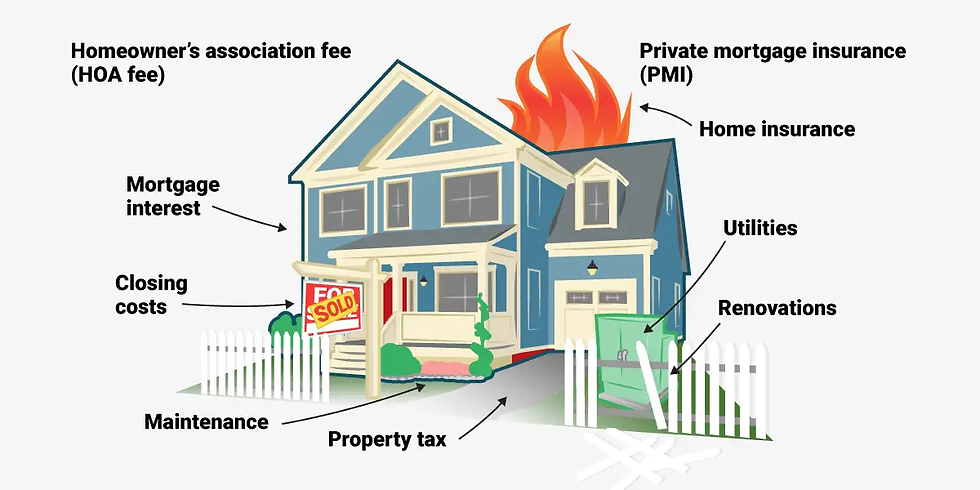
It's a reasonable starting point. But here's the problem: your mortgage payment is just one piece of a much larger financial picture. And if you're only budgeting for principal, interest, taxes, and insurance, you're going to find yourself surprised, stressed, and possibly in trouble within the first year or two of homeownership.
I've seen it happen. A buyer stretches to afford their dream home, thinking they've got the numbers figured out. Then the water heater dies. Then the property tax bill comes in higher than expected. Then they realize nobody told them about the HOA special assessment. Suddenly, "affordable" doesn't feel so affordable anymore.
In this post, I'm going to break down all the costs that come with owning a home, the ones that show up on your mortgage statement and the ones that don't. My goal is to give you a complete picture so you can budget realistically and avoid the financial stress that catches so many new homeowners off guard.
Let's get into it.
The Obvious Costs (That Still Deserve Attention)
Before we get to the hidden stuff, let's make sure we're on the same page about the basics.
Principal and Interest. This is the core of your mortgage payment. The principal pays down what you borrowed, and the interest is what the bank charges you for the privilege. Early in your loan, most of your payment goes toward interest. Over time, that ratio flips. Nothing surprising here, but it's worth understanding that your $3,000 monthly payment isn't building $3,000 in equity, especially in the early years.
Property Taxes. In most cases, your lender collects property taxes as part of your monthly payment and holds them in an escrow account. But here's what catches people: the amount you were quoted during your home search might not be what you actually pay. Property taxes are based on assessed value, and when you buy a home, it often triggers a reassessment. If you paid more than the previous owner's tax basis (which is common, especially if they owned for a long time), your taxes could jump significantly. In California, Prop 13 limits annual increases, but that initial reassessment can still be a shock. Always calculate taxes based on your purchase price, not what the seller was paying.
Homeowner's Insurance. Required by your lender, this protects you against damage to your home and liability if someone is injured on your property. Costs vary widely based on location, the age and construction of your home, your coverage limits, and your deductible. In disaster-prone areas, insurance has become increasingly expensive and sometimes difficult to obtain at all. Don't assume insurance will be cheap or easy. Get real quotes before you finalize your budget.
Private Mortgage Insurance (PMI). If you put down less than 20%, your lender will require PMI to protect themselves in case you default. This typically costs 0.5% to 1% of your loan amount annually. On a $500,000 loan, that's $2,500 to $5,000 per year, or roughly $200 to $400 per month. The good news is that PMI can be removed once you reach 20% equity. The less good news is that it adds meaningful cost in the early years when you're already stretched thin.
The Costs Most Buyers Underestimate
Now we're getting into the territory where budgets start to fall apart.
Maintenance and Repairs. Here's the rule of thumb I share with every buyer: budget 1% to 3% of your home's value annually for maintenance and repairs. For a $700,000 home, that's $7,000 to $21,000 per year. Yes, per year.
Now, you won't necessarily spend that every single year. Some years you'll barely spend anything. But then your roof needs replacing ($15,000 to $30,000), or your HVAC system dies ($8,000 to $15,000), or you discover your sewer line has collapsed ($10,000 to $25,000). These aren't hypotheticals. These are things that happen to homeowners all the time.
When you're renting, a broken water heater is your landlord's problem. When you own, it's a $1,500 surprise on a random Tuesday. You need a financial cushion for these moments, and you need to be building that cushion from day one.
Utilities. If you're moving from an apartment to a house, your utility bills are going up. More square footage means more heating and cooling. More bathrooms means more water. A yard means outdoor watering costs. I've seen buyers move into a home and discover their monthly utility bills are $300 to $500 higher than they were in their apartment. Ask the seller (or their agent) for average utility costs before you buy, and factor this into your budget.
HOA Dues. If you're buying in a community with a homeowner's association, you'll pay monthly or quarterly dues. These can range from $100 per month in a basic neighborhood association to $1,000 or more in a full-service condo or luxury community. But here's what people miss: HOA dues tend to increase over time, and they can spike suddenly if the association needs to fund major repairs or has been underfunding reserves. Before you buy in an HOA community, review the association's financial statements and reserve study. Ask about any planned or potential special assessments. I've seen buyers get hit with $20,000 special assessments within a year of purchasing. That's not a fun surprise.
Landscaping and Yard Care. If you're coming from an apartment, you may not have budgeted for this at all. Maintaining a yard costs money, whether you do it yourself (lawn mower, fertilizer, plants, irrigation repairs) or hire someone to do it for you (typically $100 to $300 per month for basic maintenance, more for larger properties or extensive landscaping). In drought-prone areas, you might face pressure or requirements to replace your lawn with drought-tolerant landscaping, which can cost thousands upfront but may save on water bills long-term.
Pest Control. Termites, rodents, ants, and other unwanted guests are your responsibility now. Many homeowners opt for quarterly pest control service, which runs $40 to $70 per visit. If you discover an infestation, treatment can cost hundreds or thousands depending on the severity. In areas with significant termite pressure, an annual termite inspection ($75 to $150) is worth the peace of mind.
The Costs Nobody Talks About
These are the ones that really catch people off guard because they're not part of any standard homebuying checklist.

Furnishing a Larger Space. Moving from a smaller place to a larger one? You're going to want to fill those rooms. That guest bedroom needs a bed. That dining room needs a table. That living room looks empty with just your old apartment couch. The urge to furnish and decorate is strong, and it's easy to drop $10,000, $20,000, or more in the first year on furniture, window treatments, rugs, and decor. Budget for this consciously, or you'll end up putting it on credit cards and paying interest on top of everything else.
Immediate Repairs and Upgrades. Your home inspection probably identified deferred maintenance or items that should be addressed soon. Maybe the inspector flagged the electrical panel as outdated, or noted that the deck is showing signs of rot, or mentioned that the windows are single-pane and inefficient. Even if nothing is an emergency, you'll likely want to address some of these items in your first year. Budget for it.
Tools and Equipment. Homeownership requires gear. A lawn mower. A ladder. Basic hand tools. A drill. A wet/dry vacuum. A pressure washer (optional but surprisingly useful). If you're starting from scratch, outfitting yourself with the basics can easily run $500 to $1,500. You can spread this out over time and buy things as you need them, but the costs add up.
The Time Cost. This one isn't in dollars, but it's real. Owning a home takes time. Time to maintain the yard. Time to deal with repairs. Time to wait for the plumber. Time to research contractors and get quotes. Time to clean more square footage. If you're coming from a rental where your landlord handled everything, the adjustment can be significant. Some people love the hands-on aspect of homeownership. Others find it exhausting. Be honest with yourself about which camp you're in.
The Opportunity Cost
Here's a perspective that doesn't get discussed enough: the money you tie up in your home is money that isn't invested elsewhere.

When you make a down payment, that cash is now locked in your home's equity. It's not earning returns in the stock market. It's not growing in a retirement account. It's sitting in an asset that may or may not appreciate at a rate that beats other investments.
I'm not saying homeownership is a bad investment. For most people, it's a solid forced savings mechanism and provides stability and quality of life that renting doesn't. But the "renting is throwing money away" narrative is oversimplified. There are scenarios where renting and investing the difference comes out ahead financially. The right choice depends on your market, your timeline, your risk tolerance, and your personal priorities.
The point is to go in with eyes open. Understand what you're choosing and what you're giving up.
How to Build a Realistic Budget
So how do you actually budget for all of this? Here's the framework I use with my clients.
Start with your all-in monthly housing cost. This includes principal, interest, property taxes, homeowner's insurance, PMI if applicable, and HOA dues. This is your baseline.
Add a maintenance reserve. Take 1.5% of your home's value and divide by 12. For a $600,000 home, that's $750 per month that you should be setting aside for maintenance and repairs. You don't have to spend it every month, but it should be accumulating in a dedicated savings account so it's there when you need it.
Add increased utilities. Estimate what your utilities will actually cost in your new home, not what you paid in your apartment or what you're hoping they'll be. Add any difference to your monthly budget.
Add recurring services. Landscaping, pest control, pool maintenance if applicable, house cleaning if you use it. These are regular costs that need to be accounted for.
Leave room for the unexpected. Beyond your maintenance reserve, you should have an emergency fund that covers 3 to 6 months of expenses. Homeownership increases your exposure to unexpected costs, so if anything, your emergency fund should be larger than it was when you were renting.
If you add all this up and the number feels uncomfortably high, that's important information. It might mean you should look at less expensive homes, or it might mean you should continue renting while you build up more savings. There's no shame in waiting until you're truly ready.
The Bottom Line
Owning a home is wonderful. There's real value in having a place that's yours, that you can customize and improve, where you can build a life without worrying about lease renewals or landlord decisions. I'm a homeownership advocate, genuinely.
But I'm also an advocate for going in prepared. The mortgage payment is just the beginning. Property taxes, insurance, maintenance, repairs, utilities, HOA costs, furnishing, landscaping, and a dozen other expenses are part of the package. If you budget only for the mortgage and ignore the rest, you're setting yourself up for financial stress.
Do the math honestly. Build your reserves. Understand what you're signing up for. And then, when you're confident you can handle the full picture, go find yourself a home and enjoy everything that comes with it.
That's how you set yourself up for success.


Comments