
Rent vs. Buy: An Honest, Math-Based Guide to the Biggest Financial Decision You'll Make

I'm going to be straight with you: I'm a real estate professional who helps people buy homes for a living. You might expect me to tell you that buying is always better, that renting is throwing money away, that homeownership is the American dream and you're falling behind if you don't get in the game.
I'm not going to tell you any of that.
Because here's what I've learned after years in this business: buying a home is the right decision for some people in some situations, and renting is the right decision for other people in other situations. The "rent is throwing money away" crowd and the "homeownership is a scam" crowd are both wrong. The truth is more nuanced, more personal, and more dependent on actual math than either side wants to admit.

In this post, I'm going to give you a framework for thinking through this decision that's based on real numbers, not emotions or conventional wisdom. I'll walk you through the actual costs involved, show you how to compare them fairly, and then give you five real-world scenarios where the math points clearly in one direction or the other.
Let's get into it.
Why the Usual Comparison Doesn't Work
When most people think about rent versus buy, they do something like this: they look at a house, figure out what the mortgage payment would be, and compare it to their current rent. If the mortgage is lower, they think buying is the obvious choice. If rent is lower, maybe they stick with renting a while longer.
This comparison is fundamentally flawed.
Here's why: your mortgage payment is not equivalent to rent. When you pay rent, 100% of that money is gone forever. You get housing in exchange, but you build no equity. It's a pure expense.
When you pay a mortgage, part of that payment is interest (which is gone forever, just like rent), but part of it is principal repayment (which builds your equity in the home). You're essentially paying yourself with the principal portion. So comparing your full mortgage payment to rent isn't apples to apples. You're comparing an expense to a combination of an expense and forced savings.
To make a fair comparison, we need to look at the unrecoverable costs on both sides. For renting, that's simple: it's your rent. For owning, it's more complicated.
The Unrecoverable Costs of Homeownership
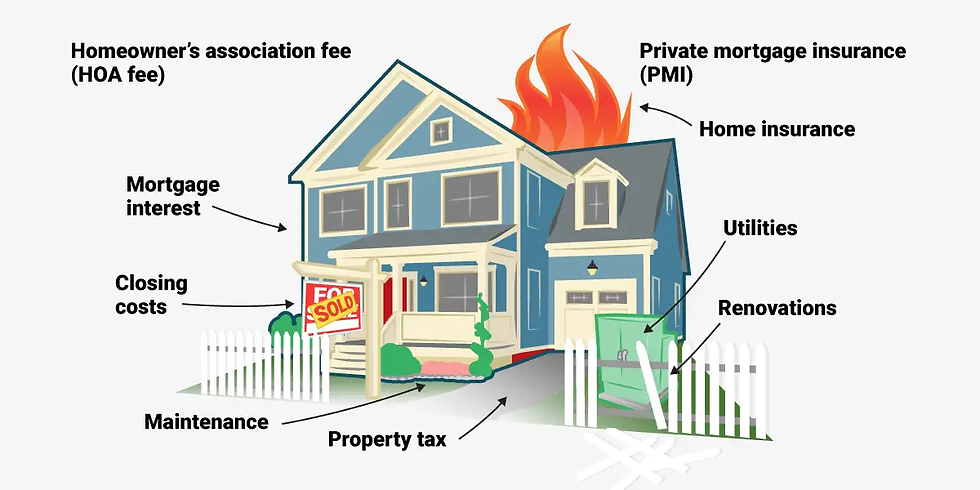
When you own a home, there are three categories of costs that you pay with no residual value. Money spent, never to be seen again, in exchange for having a place to live.
Property Taxes
You'll pay these every year regardless of whether you have a mortgage. They vary by location but typically run about 1% to 1.5% of your home's value annually. In some high-tax states like New Jersey or Illinois, it can be closer to 2% or more. In lower-tax states, it might be under 1%. For our purposes, I'll use 1% as a baseline, but you should look up actual rates for your area.
Maintenance and Repairs
Roofs need replacing. HVAC systems die. Plumbing breaks. Kitchens get outdated. As a homeowner, all of this is on you. The standard estimate is 1% of your home's value per year, though this can vary based on the age and condition of the property. Older homes typically cost more to maintain. Newer construction might cost less in the early years but will catch up eventually.
Cost of Capital
This is where it gets interesting, and where most people's analysis falls apart. Whether you finance your home with a mortgage or pay cash, there's a cost of capital involved. If you have a mortgage, you're paying interest on that borrowed money. If you pay cash (or make a down payment), you've tied up money in real estate that could have been invested elsewhere, likely in stocks, which historically earn higher returns. This is called opportunity cost, and it's a real economic cost even though you never write a check for it.
Let me break this down further.
Cost of Debt (Mortgage Interest): If you take out a mortgage, you pay interest. As of late 2024 and into 2025, mortgage rates have been hovering in the 6.5% to 7% range for a 30-year fixed loan. This is dramatically higher than the 3% rates we saw just a few years ago, and it significantly changes the rent-versus-buy calculus.
Cost of Equity (Opportunity Cost) For your down payment and any equity you build, there's an opportunity cost. That money could have been invested in a diversified stock portfolio. Historically, stocks have returned roughly 7% annually in nominal terms, while residential real estate (nationally, not cherry-picked hot markets) has returned around 3-4% after accounting for all costs. The difference, roughly 3-4%, represents the opportunity cost of having your money in your home instead of the stock market.
Updating the Math for Today's Market
Back in 2019, financial planner Ben Felix popularized something called the 5% Rule. The idea was that homeowners could expect to pay about 5% of their home's value annually in unrecoverable costs: 1% for taxes, 1% for maintenance, and 3% for cost of capital.
That 3% cost of capital made sense when mortgage rates were around 3% and the opportunity cost of equity was also around 3%. Whether you financed heavily or paid cash, your cost of capital worked out to roughly the same number.
But today, with mortgage rates at 6.5% or higher, the math has shifted significantly. The 5% Rule is now more like a 7-8% Rule for most buyers.
Here's how it breaks down with a typical 20% down payment and an 80% mortgage at 6.5%:
Property Taxes: 1% Maintenance: 1% Cost of Capital: 80% of home financed at 6.5% = 5.2%, plus 20% down payment with 3.5% opportunity cost = 0.7%. Total cost of capital: roughly 6%.
Total Unrecoverable Cost: approximately 8% of the home's value per year.
If you're putting down more money, the percentage drops somewhat because you're replacing expensive mortgage debt with cheaper opportunity cost. An all-cash buyer might be looking at closer to 5.5-6%. But for the typical buyer using financing, 8% is a reasonable estimate in today's rate environment.
How to Use This Framework
Here's the practical application. Take the value of the home you're considering and multiply by your applicable percentage (let's use 8% for a typical financed purchase). Divide by 12 to get a monthly figure. That's your breakeven rent.
For example, if you're looking at a $600,000 home:
$600,000 × 8% = $48,000 per year in unrecoverable costs $48,000 ÷ 12 = $4,000 per month
If you can rent a comparable home for less than $4,000 per month, renting is likely the better financial decision. If comparable rentals cost more than $4,000, buying starts to make more sense from a pure cost perspective.
You can also work backward. If you're paying $3,000 per month in rent and wondering what you can "afford" to buy with equivalent unrecoverable costs:
$3,000 × 12 = $36,000 per year $36,000 ÷ 8% = $450,000
Paying $3,000 in rent is roughly equivalent, in terms of unrecoverable costs, to owning a $450,000 home. Not a $600,000 home just because you could qualify for that mortgage.
What This Framework Doesn't Capture
Before we get to the case studies, I want to be clear about what this analysis leaves out.
Appreciation. This framework assumes you're not counting on your home to appreciate significantly faster than the historical average. If you buy in a market that booms, you'll come out ahead. If you buy in a market that stagnates or declines, you'll come out behind. Over the long run, nationally, housing has appreciated at roughly the rate of inflation plus a small premium. Banking on outsized appreciation is speculation, not investment.
Tax Benefits. Mortgage interest and property taxes are deductible if you itemize, but since the standard deduction increased significantly in 2018, fewer homeowners actually benefit from this. Run the numbers for your specific situation rather than assuming you'll get a tax break.
Forced Savings. There's a real behavioral benefit to homeownership in that your mortgage payment forces you to build equity. If you're the type who would rent and spend the difference rather than invest it, homeownership imposes a discipline that might benefit you. But the framework assumes you're actually investing the savings from renting. If you're not, the comparison changes.
Non-Financial Factors. Stability, the ability to customize your space, pride of ownership, roots in a community. These matter. They're just not captured in a financial model.
Now, let's look at some real-world scenarios.

Case Study 1: The Bay Area Tech Worker
Situation: Maya is a software engineer in San Jose earning $200,000 per year. She's been renting a nice two-bedroom apartment for $3,200 per month. She's considering buying a comparable condo listed at $850,000. She has $170,000 saved for a 20% down payment.
The Math:
Her unrecoverable cost of owning would be approximately: $850,000 × 8% = $68,000 per year, or about $5,667 per month
She's currently paying $3,200 in rent.
The difference: $5,667 - $3,200 = $2,467 per month, or nearly $30,000 per year that she would pay in additional unrecoverable costs by buying.
Other Considerations:
Maya works in tech, where layoffs happen and opportunities in other cities might arise. If she had to sell after two or three years, the transaction costs (agent commissions, closing costs, transfer taxes) would likely eat up any equity she'd built. Bay Area appreciation has been strong historically, but future returns are uncertain, and prices have already been flat or declining in some segments.
Verdict: Renting wins.
At these price-to-rent ratios, Maya is better off continuing to rent and investing the difference. She maintains flexibility for career moves, avoids concentration risk in a single expensive asset, and keeps her monthly costs significantly lower.
Case Study 2: The Midwest Family
Situation: James and Priya are in their early 30s with a toddler. They live in Columbus, Ohio, and currently rent a three-bedroom house for $2,100 per month. They've found a similar house for sale at $320,000 and have $64,000 (20%) for a down payment.
The Math:
Unrecoverable cost of owning: $320,000 × 8% = $25,600 per year, or about $2,133 per month
They're currently paying $2,100 in rent.
The difference is minimal, just $33 per month more in unrecoverable costs.
Other Considerations:
James and Priya both work for stable employers (he's a hospital administrator, she's a school counselor) and plan to stay in Columbus for at least a decade. They want stability for their child and the ability to customize their home. Their jobs are not going anywhere, and Columbus has a diversified economy.
With a purchase, they'd also be building equity with each mortgage payment. Yes, early payments are mostly interest, but they're still paying down principal each month. Over a 10-year horizon, they'd build meaningful equity while their monthly outlay remains similar to renting.
Verdict: Buying wins.
When the unrecoverable costs are roughly equal, the tie goes to buying because you're building equity. Add in their long time horizon, stable employment, and desire for stability, and purchasing makes sense.
Case Study 3: The New Graduate
Situation: Tyler just finished law school and started at a firm in Chicago making $190,000. He has $80,000 in student loans and minimal savings. He's renting a one-bedroom apartment downtown for $2,400 per month. His parents are pressuring him to "stop throwing money away on rent" and are offering to help with a down payment on a $500,000 condo.
The Math:
Unrecoverable cost of owning: $500,000 × 8% = $40,000 per year, or about $3,333 per month
He's paying $2,400 in rent, a difference of $933 per month.
Other Considerations:
Tyler has significant student debt. BigLaw careers are notoriously uncertain. Many associates leave within a few years, and if he switches to a lower-paying role (government, nonprofit, in-house), he might struggle with the mortgage. He also doesn't know where he wants to live long-term. What if he meets someone who lives in a different neighborhood? What if he wants to move to a different city?
His parents' offer is generous, but accepting it would tie him to an expensive asset at a time when flexibility has enormous value.
Verdict: Renting wins, decisively.
Tyler should pay down his student loans, build his own savings, and figure out what he wants his life to look like before taking on a six-figure asset. The "throwing money away" framing is exactly the kind of thinking that leads people into bad financial decisions.
Case Study 4: The Empty Nesters
Situation: Robert and Linda are in their late 50s. Their kids have moved out, and they're rattling around in a four-bedroom house they own outright in suburban Phoenix. The house is worth about $550,000. They're considering selling and renting a two-bedroom apartment downtown to be closer to restaurants, culture, and their friends.
The Math:
Their current unrecoverable costs: $550,000 × 5.5% (all cash, so lower cost of capital) = $30,250 per year, or about $2,521 per month
Comparable two-bedroom apartments downtown rent for about $2,200 per month.
If they sell, they'd net roughly $520,000 after transaction costs. Invested conservatively in a 60/40 portfolio, they might expect around 5% annual returns, generating $26,000 per year, or $2,167 per month.
Other Considerations:
Robert and Linda are tired of maintaining a large house. The yard work, the repairs, the cleaning. They want to simplify. Downtown living would put them closer to the activities they enjoy. They have adequate retirement savings and don't need to preserve the home equity for their heirs (their kids are financially independent).
Verdict: Renting wins, with lifestyle benefits.
By selling and renting, they free up over $500,000 to invest, reduce their monthly housing costs, eliminate maintenance headaches, and gain the flexibility to travel or relocate. For them, renting isn't a step backward. It's a strategic choice that aligns with their life stage.
Case Study 5: The Long-Term Planner in a Balanced Market
Situation: Kenji and Maria are in their mid-30s, married, with stable government jobs in Raleigh, North Carolina. They currently rent a three-bedroom townhouse for $2,300 per month. They've saved $100,000 and are looking at purchasing a similar townhouse for $400,000.
The Math:
Unrecoverable cost of owning: $400,000 × 8% = $32,000 per year, or about $2,667 per month
They're paying $2,300 in rent, a difference of $367 per month.
But let's look at this over time. With a 30-year mortgage, after 10 years they'd have paid down roughly $65,000 in principal. Their total housing payments (mortgage + taxes + insurance + maintenance) would be higher than rent, but a significant portion would be building equity.
Meanwhile, if they continued renting at $2,300 per month and invested the $100,000 down payment plus the $367 monthly difference, after 10 years at 7% returns they'd have approximately $280,000.
The townhouse, assuming 3% annual appreciation, would be worth about $538,000. With $65,000 in principal paydown plus their original $80,000 equity (20% of $400,000), their equity would be roughly $268,000, plus the remaining $145,000 of equity from appreciation, totaling about $413,000 minus selling costs of approximately $35,000, leaving them with about $378,000.
Other Considerations:
Kenji and Maria have extremely stable jobs (government positions with good job security), plan to stay in Raleigh long-term, and value the stability of fixed housing costs (their mortgage payment won't increase, while rent likely will). The Raleigh market has seen steady growth without the extreme volatility of coastal metros.
Verdict: Buying wins, over the long term.
The monthly cost difference is modest, their time horizon is long, and they value stability. The ability to lock in housing costs with a fixed-rate mortgage provides inflation protection that renting doesn't. Over 10+ years, they're likely to come out ahead financially while also enjoying the non-financial benefits of ownership.

Key Takeaways
If you've made it this far, here's what I want you to remember:
The comparison isn't mortgage versus rent. It's unrecoverable costs versus unrecoverable costs. Make sure you're accounting for property taxes, maintenance, AND cost of capital when you evaluate buying.
The old 5% Rule is now closer to 7-8% for most buyers. Higher mortgage rates have shifted the math significantly. Don't use outdated rules of thumb.
Time horizon matters enormously. Buying comes with substantial transaction costs (typically 8-10% between buying and selling). If you're not staying at least 5-7 years, those costs will likely eat up any equity you build.
Local market conditions vary wildly. In high-cost metros with low price-to-rent ratios (San Francisco, New York, Seattle), renting often wins. In more affordable markets where rents are relatively high compared to purchase prices (much of the Midwest and South), buying often wins.
Your personal circumstances matter as much as the math. Job stability, life stage, flexibility needs, and personal preferences are all legitimate factors. The financially optimal choice isn't always the right choice for your life.
"Throwing money away on rent" is a misleading frame. Rent pays for shelter, flexibility, and freedom from maintenance. Homeownership has its own set of costs that don't build equity. Neither is inherently wasteful.
The Bottom Line
There's no universal answer to rent versus buy. Anyone who tells you otherwise is either selling you something or hasn't done the math.
What I can tell you is that the decision deserves more analysis than most people give it. Run the numbers for your specific situation. Be honest about your time horizon and your flexibility needs. Don't let social pressure or outdated conventional wisdom push you into a decision that doesn't make sense for your life.
And if you need help thinking through the specifics for your situation, that's what I'm here for. Whether you end up buying or continuing to rent, my goal is to help you make the decision that's actually right for you.


Comments